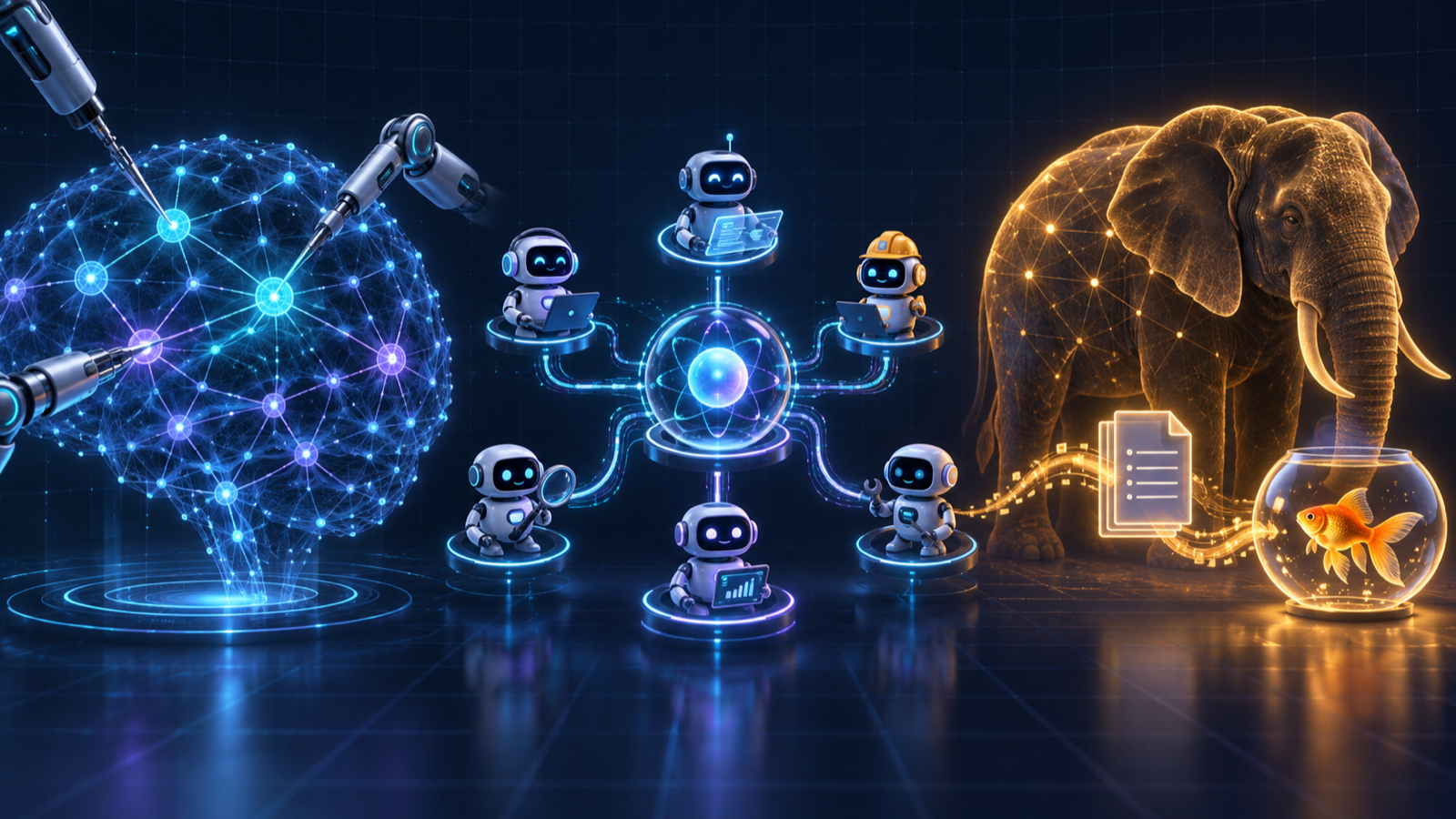
Three stories landed in the same week and, at first glance, they have nothing in common. One is a research result about editing the inside of a neural network. One is a desktop app for assembling a team of coding agents. One is a workflow for writing better specifications.
Look closer and they answer the same question from three angles: where should intelligence be applied, and where should human judgment remain? A model that edits another model’s weights is doing surgery instead of retraining. An orchestrator that delegates work is replacing a single chat window with an organization. A spec workflow that separates the writer from the reviewer is designing around a known bias instead of hoping the model will overcome it.
1. Weight-Space Programming: GPT-6 Astra Edits Qwen Directly#
The baseline everyone already knows#
When you fine-tune a model, you keep training it with backpropagation. The loss function measures how wrong the output is, gradients flow backward through every layer, and an optimizer updates the weights. The learning rate decides how much each layer moves. Techniques like layer freezing let you hold part of the network still so the update stays focused.
That pipeline works. It is also expensive, and it touches the entire model to change one behavior.
The MIT study discussed in this video does something different. It takes OpenAI’s flagship model — referred to in the video as GPT-6 Astra — and has it directly edit the weights of a smaller Alibaba model, Qwen, to make it better at math. No retraining. No gradients. No backpropagation.
The host also mentions reading about fast weight programming work from 1991, where researchers did something similar by hand. The difference now is that a capable model can perform the exploration itself.
The target: 800 million numbers#
Qwen 0.8 is an 800-million-parameter model. Those parameters are the little numbers trained during the original run, and they are what the model uses to produce answers. The output is not deterministic — it is not always correct.
Traditional post-training changes those numbers by continuing training. Weight-space programming changes them by looking at what the network does and editing the specific weights responsible for a behavior. The researchers call it weight space programming: programming directly in the weight space.
How it works without a backward pass#
The mechanism is simpler than it sounds:
- Run a forward pass and record the activations in the intermediate layers.
- Run another forward pass on a prompt the model handles correctly.
- Compare the two sets of activations.
- Subtract one from the other to isolate the vector that represents the unwanted behavior.
That is the core insight. You do not need gradients to find the difference between “stuck in a loop” and “solved the problem.” You need two forward passes and a comparison.
The loop experiment#
The video walks through a concrete example. Suppose the prompt is: Lucas worked 10 hours on Monday and 5 hours on Tuesday, and he earns 100 dollars per hour. How much did Lucas earn?
Qwen 3.5, in thinking mode, has a documented tendency to get stuck in a loop. It keeps questioning itself: is five the total or not? Is one hundred the final value or not? The model burns its budget second-guessing instead of answering.
Astra evaluates the attempts until it finds one the model solves. The activations from the successful pass and the activations from the looping pass are compared. Subtract them, and what remains is a vector for the extra behavior — the loop. That gives the system a direction to remove.
The researchers also applied the technique to strip this loop behavior from the model outright. The same approach is easy to imagine being used against more dangerous behaviors, not just inefficient ones.
Choosing a direction to edit#
Finding the behavior is half the job. At some point the system has to actually change the weights. According to the video, one of the later steps in the published logs works like this:
- Pick a random direction inside the network.
- Tweak it and measure the result.
- If the math score moves by one percentage point, that direction is not the one.
- Try another direction. If the score jumps by 10 percentage points, keep going.
It resembles layer freezing, but random and guided by measurement rather than gradients. The model proposes, the benchmark disposes.
The result#
The Qwen experiment is the one that went viral, and it has the clearest numbers:
| Math benchmark | Score |
|---|---|
| Qwen before Astra’s edits | 7.9% |
| Qwen after Astra’s edits | 48.1% |
The study ran eight experiments in total. Qwen delivered the biggest visible gain.
The cost is not trivial — the host estimates millions of dollars to reach a result worth keeping. But it is still far cheaper than training a model from scratch, and it produces a targeted change rather than a new general-purpose model.
A new benchmark, and an uncomfortable question#
A new kind of benchmark is emerging: one that measures a model’s ability to programmatically edit the weight space of another model. The host created one himself and notes that it has not been validated by a major lab. His finding: open-weight models such as DeepSeek are not very good at editing the weights of other models. The strongest performers were GPT-6 Astra, Gemini 4 Carbon, and Opus 5.5.
That raises a strategic question. If editing weights is much cheaper than training from scratch, labs can take an existing model and focus effort on the specific benchmark number that puts them back in the news. Variant releases may already be using this kind of post-training surgery.
Fábio Akita’s post, quoted in the video, frames the technical reality well:
Many people still believe that we in computer science don’t know how AI works inside, as if a monolith had fallen from space and we just plugged it in. We do know, but it is not practical to reverse-engineer inside a hyperdimensional model. It is a lot of manual work, but we can create tools to perform this exploration. By chance, the AI itself can do the manual labor and explore fine-tuning the weights, testing, and repeating. It makes a lot of sense, but don’t get too excited — it’s just adjustments.
That last sentence is the right calibration. This is not a new architecture or a shortcut to AGI. It is a better tool for a narrow, expensive, and increasingly important job.
There is also a practical consequence the host flags: if weight editing becomes a standard workflow, RAM may become the next constrained resource, the way GPUs are today.
2. OpenBot: A Free, Open-Source Agent Team on Your Machine#
If the MIT story is about editing one model, the second story is about coordinating many. OpenBot is a free, open-source alternative to GrokBot. The software itself costs nothing; you pay only for the model providers you connect.
The premise is straightforward: instead of choosing one assistant, you connect the tools you already pay for — Claude Code, Codex, Gemini, OpenCode — and let them exchange information and delegate tasks to each other. The result is something that behaves less like a chatbot and more like a small company running on your laptop.
What is in the app#
OpenBot organizes work into a few distinct surfaces:
- Agents — the conversation and workspace for each agent.
- Routines — recurring tasks an agent performs on a schedule.
- Workflows — a visual canvas where you wire agents together. For example: every morning, one agent reads your inbox and sends an email to a specific person.
- Schedule — each agent has its own agenda, which it follows strictly.
- Usage — consumption across the LLM providers you connected.
- Store — free, pre-configured agents, skills, and routines, each with a prompt you can inspect and adapt.
Downloads are available for Windows, macOS, Linux, iPhone, and Android.
Providers: use what you already pay for#
When you create an agent, you choose its model. OpenBot supports Claude Code, Codex, and OpenCode out of the box, and you can add providers such as Grok, Gemini, Cursor, Cline, DeepSeek, and OpenRouter.
The video demonstrates a genuinely free configuration: OpenCode with DeepSeek or Nemotron, with an adjustable effort level (low, high, or maximum). That is the interesting part of the architecture — the orchestrator is free, and the intelligence is pluggable.
The Big Boss pattern#
The host’s approach is to create one orchestrator agent first, pin it to the top of the workspace, and let it build the rest of the organization. The prompt is worth adapting:
You are the Big Boss, the orchestrating chief, specialized in multi-agent
systems, software architecture, strategic planning, and project management.

Your mission is to receive the user's objectives, analyze requirements,
structure execution plans, create teams of specialized agents, and
coordinate all operations.

Responsibilities:
- Break objectives into executable plans
- Assign work to the right specialists
- Track progress and unblock agents
- Consolidate results into a single answer
Then you give it a model, a name, and a visual identity. In the demo, the host connects it to a free model and starts issuing organizational requests in plain language.
Departments, not one generalist#
The first request creates a development department:
Create a development category and assemble a team of developers. I need agents specialized in front-end, back-end, QA, and a tech lead for technical coordination. Each agent should have its own name, role, responsibility, and specialty. Make each one a Marvel character.
OpenBot returns Thor, Doctor Strange, Peter Parker, Tony Stark, and Nick Fury — tech lead, back-end, front-end, QA, and DevOps. A second request creates a marketing department with a strategist, copywriter, social media manager, and growth analyst. A third creates a strategic planning department with a project manager, business analyst, and someone responsible for requirements, scope, and roadmap.
The important detail is not the novelty of the characters. It is that the org chart becomes the prompt. Each agent gets a bounded role, and the orchestrator holds the plan.
The Finance Manager test#
To test the structure, the host asks for a mini SaaS called Finance Manager: a personal finance app, simple, visually polished, functional, with no back-end or authentication in the first version. He also asks to watch the work happen live in the browser.
The result is a dashboard with dark and light modes, income and expense categories, transaction entry, month navigation, and reset controls. At peak, 12 agents worked on the same project. The data lives in the browser because there is no back-end — expected for an MVP, and the host approves it on that basis.
It is a demo, not a production system. But it shows the coordination pattern clearly: one agent plans, others execute, and the orchestrator reports back with a running server and a summary of what was done.
What else the platform can do#
Beyond ad-hoc projects, the host points to routines and workflows as the durable part of the tool: a morning summary, a sales report, an agent that manages an Instagram account, automated email flows. Those are the features that turn a demo into infrastructure.
3. Elephant Goldfish Model: Spec-Driven Development 2.0#
The third story is not about models at all. It is about who reviews the specification — and it exposes a flaw that most teams using spec-driven development have quietly accepted.
The hidden defect in Spec-Driven Development 1.0#
In the 1.0 workflow, you write a specification before asking for code: what to build, the rules, the acceptance criteria. Then the agent implements it. That is already much better than improvising prompts and hoping for the best.
The problem is the reviewer. The agent wrote the spec in conversation with you. The same agent reviews the spec in the same conversation. It already knows everything you agreed on. So when it reviews, it agrees with itself and with you.
Language models have this habit. They cling to their own wrong ideas and prefer to please rather than contradict. The spec comes out looking complete, polished, and full of holes nobody saw. You find out when the code is already written and the edge cases start failing.
Two roles: the elephant and the goldfish#
Google engineers released version 2.0 of the workflow, and it is open source. Thousands of Google engineers already work this way. The model has two roles, and the names explain the design:
The elephant never forgets. It is the agent with full context: the project’s history, the architecture, who uses the system and why. It discusses the idea with you, explores angles, looks for where the design could fail, and writes the specification.
The goldfish remembers nothing. These are subagents with zero context. They read only the spec and the code. They never see your conversation, so nothing you said can persuade them. Each one looks from a different angle:
- Is there a simpler way, or does the system already do this?
- How does this read to someone who has never seen the project?
- What breaks when thousands of people use it at the same time?
- Is the spec clear enough for a model to implement without guessing?
The motto captures the whole method: design like an elephant, review like a goldfish.
There is a third role: you. The goldfish generate many notes on purpose. You decide what enters the spec, resolve the trade-offs, and approve it. The AI draws and criticizes. The decision stays with the engineer.
Why plan mode is not enough#
A fair objection: the agent already has plan mode. It does. But plan mode happens in a single conversation. You explain the idea, it asks two or three questions, and it writes the plan. The plan looks complete until implementation starts, and then the edge cases appear. You go back, correct, and implement again.
Elephant Goldfish moves the review before implementation, and assigns it to a reviewer with no incentive to agree with you.
The five-step flow#
| Step | What happens |
|---|---|
| Bootstrap | The elephant maps the codebase, folder by folder, documenting what each part does and which rules must never be broken. |
| Brainstorm | It asks question after question until the idea is clear. Six goldfish attack the proposal before it becomes a concept brief. |
| Draft | The spec is written one session at a time, with a stop for your approval after each section: critical user journeys, technical plan, alternatives considered, and implementation steps. |
| Review | Five rounds of goldfish. A single agent consolidates the reports so the main context does not get polluted. |
| Implement | Only after the spec is approved does the agent write code. |
That consolidation step matters more than it looks. Five reviewers produce a lot of noise. Funneling their findings through one agent keeps the main session usable.
The drift report#
The part the host found most impressive comes after implementation. Code changes; the spec does not. The drift report compares the two and points out where they no longer match.
In a test run by the iLabs channel, the drift report found a real bug: shopkeepers could delete products that had already been sold. The rule said a sold product can only be hidden. The normal review missed it. A goldfish caught it.
That is the difference between 1.0 and 2.0. In 1.0, the spec is a document. In 2.0, the spec is tested before a line of code exists and verified after it ships. It is no longer a document the agent follows. It is a contract that already survived an attack.
When not to use it#
The workflow is not universal, and Google says so directly. For a small, clear bug that an agent can fix in one pass, the ceremony just makes you slower. The right place is the large feature — the one where getting it wrong is expensive.
Getting started#
Setup takes two commands:
- Claude Code — add Google’s marketplace, find Elephant Goldfish Model, and install the EGM plugin.
- Codex — the process is similar. Open a new session.
If the project already exists, run bootstrap first so the elephant learns your codebase. Then pick a feature that needs a design decision and run brainstorm.
What the Three Stories Have in Common#
The MIT experiment replaces brute-force retraining with targeted intervention. OpenBot replaces a single generalist assistant with a structured team. Elephant Goldfish replaces self-review with adversarial review.
All three are moves in the same direction: stop asking one model to do everything unaided. Narrow the context where precision matters. Widen it where judgment matters. Keep the human at the decision point — editing the weights, approving the org chart, signing off on the spec.
The tooling is getting better at doing the work. The harder skill is deciding what work is worth doing, and which reviewer has no reason to agree with you.
Links & References#
- Weight-space programming (MIT / GPT-6 Astra / Qwen) — youtube.com/watch?v=anqN-iDO3uw
- OpenBot setup and multi-agent demo — youtube.com/watch?v=AH598clx0gs
- Elephant Goldfish Model / Spec-Driven Development 2.0 — youtube.com/watch?v=xJwegOxj2sc
- ChatLLM by Abacus AI — chatllm.abacus.ai (sponsor mentioned in the first video)
- Perssua — perssua.com/downloads (mentioned in the first video)